Construction Clean Up Rates: What General Contractors Should Budget
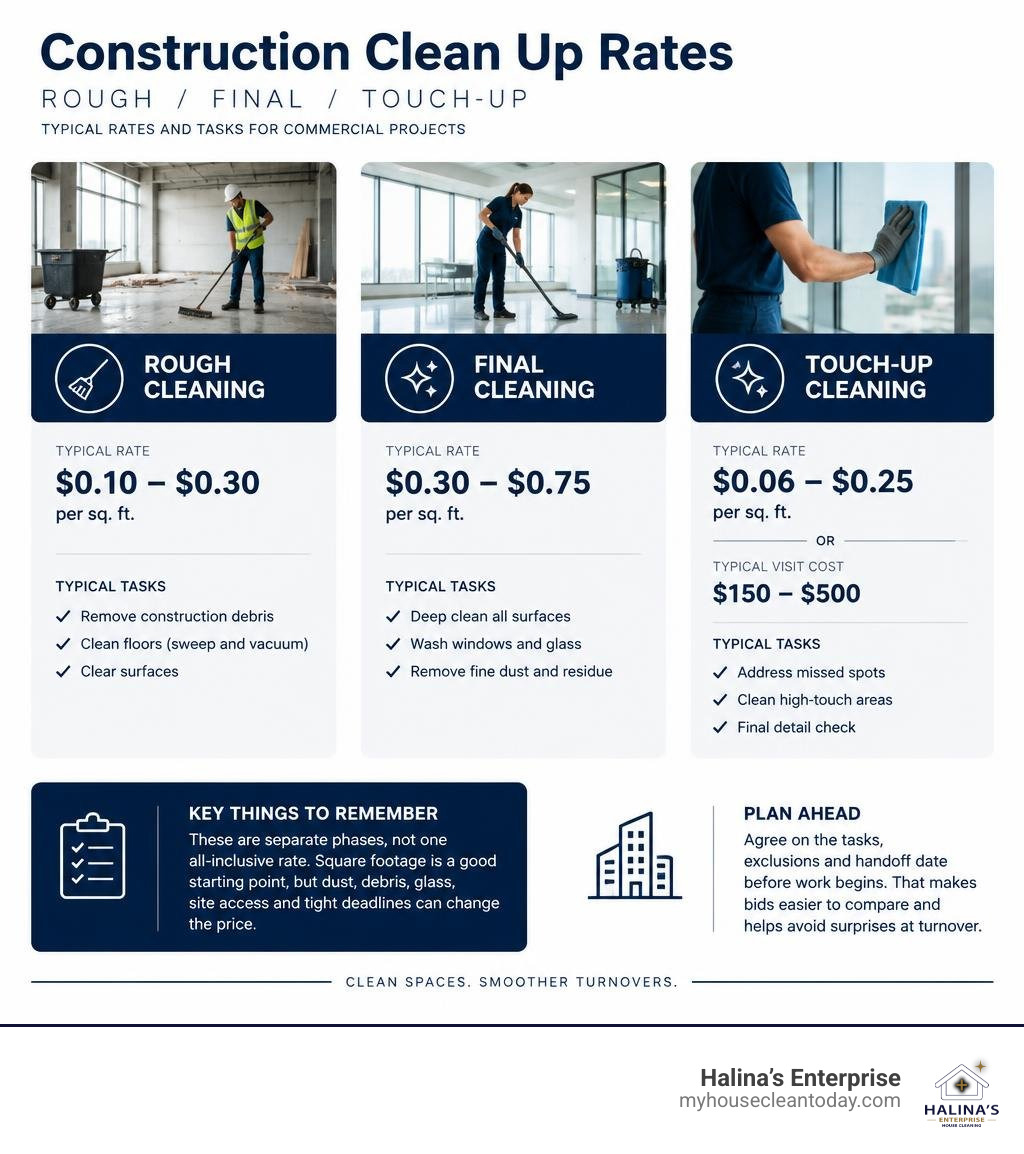
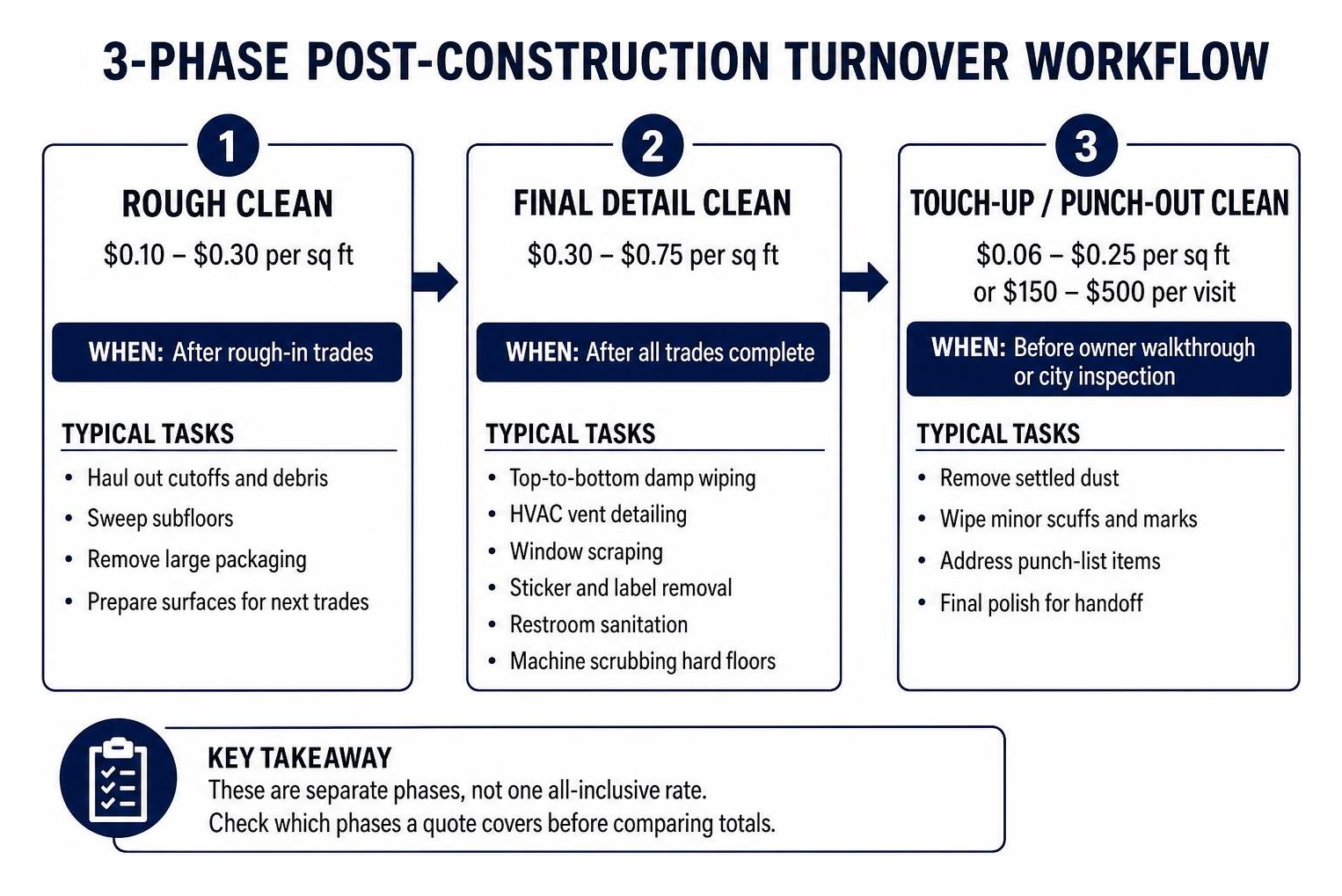
For 2026 commercial bids, rough cleaning typically runs $0.10-$0.30 per square foot, final detail cleaning $0.30-$0.75, and touch-up cleaning $0.06-$0.25. A touch-up visit may instead cost $150-$500. These are separate phases, not one all-inclusive rate. Check which phases a quote covers before comparing totals.
Square footage is a useful starting point, but dust, debris, glass, site access, and tight deadlines can change the price. At Halina’s Enterprise, we recommend agreeing on the tasks, exclusions, and handoff date before work begins. That makes bids easier to compare and helps avoid surprises at turnover.
2026 Commercial Benchmarks for Construction Clean Up Rates
Commercial builds carry strict deadlines and distinct trade schedules. When estimating trade scopes across Chicagoland, general contractors need accurate benchmarks to project turnover costs reliably. Industry data from the Construction cleanup price guide for U.S. projects indicates that total post-construction cleaning packages generally sit between $0.15 and $0.85 per square foot nationwide, with full detailing of complex builds reaching $1.00 per square foot.
Regional labor dynamics, facility types, and soil volumes directly influence these benchmarks. In the Chicago metropolitan area, labor rates, disposal costs, and stringent building guidelines mean budgets must account for realistic production times rather than generic square-footage estimates.
| Facility Type | Average Size (Sq Ft) | Typical Phase Breakdown | Estimated Total Project Cost |
|---|---|---|---|
| Small Commercial / Retail | 2,000 – 5,000 | Rough & Final Clean | $500 – $5,000 |
| Mid-Size Corporate Office | 5,000 – 15,000 | Rough, Final, & Touch-Up | $2,500 – $9,500 |
| Multi-Floor Corporate Build | 20,000 – 50,000+ | Phased 3-Stage Turnover | $8,000 – $25,000+ |
| Medical / Clinical Fit-Out | 3,000 – 10,000 | Sanitization & Detail Final | $1,800 – $7,500 |
| Industrial / Warehouse Shell | 20,000 – 100,000+ | High-Dust & Floor Scrub | $3,000 – $15,000 |
Rough Clean vs. Final Clean vs. Touch-Up Pricing
Every phase in post-construction cleaning serves a specific operational purpose during handover:
- Rough Cleaning ($0.10 to $0.30 per sq ft): Performed after framing, drywalling, plumbing, and electrical rough-ins are complete. Crews haul out cutoffs, sweep subfloors, remove large packaging, and prepare surfaces for flooring installation, painting, and fixture setting.
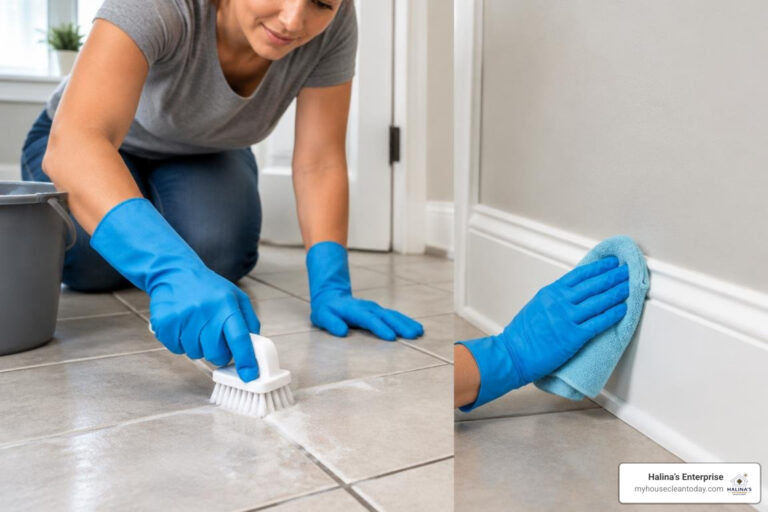
- Final Detail Cleaning ($0.30 to $0.75 per sq ft): Conducted after all trades finish primary work. This stage covers top-to-bottom damp wiping, HVAC vent detailing, window scraping, sticker removal, restroom sanitation, and machine scrubbing hard floors.
- Touch-Up / Punch-Out Cleaning ($0.06 to $0.25 per sq ft or $150 to $500 per visit): Scheduled right before the owner walkthrough or city inspection. It clears settled airborne dust and scuffs left behind by minor trade corrections.
Scale and Commercial Facility Type Variations
Different commercial buildings require varying levels of labor. A 50,000-square-foot warehouse shell with open concrete slabs has a much lower unit cost than a 5,000-square-foot medical clinic containing complex millwork, high sanitization requirements, and dense restroom layouts. For facilities transitioning into active daily operations, aligning initial turnover quality with long-term commercial cleaning standards ensures consistent hygiene and protects brand reputation.
Retail spaces with expansive exterior curtain walls, display glass, and polished stainless fixtures require dedicated glass crews. Conversely, multi-floor educational or office fit-outs require structured elevator scheduling and multi-stage waste handling across floors.
Comparing Bidding Models: Square Foot, Hourly, and Flat Project Fees
Cleaning contractors price commercial cleanup projects using three main billing models: per-square-foot rates, hourly rates, and fixed flat-rate project fees. Selecting the right model depends on project scope, site readiness, and risk factors.
| Pricing Model | Best Used For | Contractor Advantages | Potential Pitfalls |
|---|---|---|---|
| Per Square Foot | Well-defined scopes, new construction shells, standard tenant buildouts | Transparent, scalable, easy to benchmark against industry averages | Ignores vertical complexity, dense soil conditions, or heavy glass volume |
| Hourly Rate ($25–$50/worker) | Small renovations, unpredictable punch-list items, open-ended scopes | You pay only for actual time spent on unpredictable sites | Budget uncertainty for general contractors; can incentivize slower production |
| Flat Project Fee | Multi-phase builds, fixed turnarounds, complex commercial facilities | Fixed cost predictability for the GC; rewards efficient contractor systems | Requires clear exclusions to prevent unbilled scope creep |
Analyzing Per-Square-Foot Construction Clean Up Rates
Square-footage pricing remains the most common metric used by general contractors for standard tenant improvements and ground-up builds. When assessing quotes based on unit rates, contractors should evaluate how the soil load affects technician speed:
- Light Soil (500–1,200 sq ft/hr per technician): Minor surface dust, basic fixture wipe-down, simple floor sweeps. Rates average $0.15–$0.25/sq ft.
- Moderate Soil (300–600 sq ft/hr per technician): Drywall sanding residue, adhesive residue on frames, uncleaned interior windows. Rates average $0.25–$0.40/sq ft.
- Heavy Soil (150–300 sq ft/hr per technician): Thick mortar splatters, paint overspray on glass and trim, uncontained renovation dust. Rates run $0.40–$0.75+/sq ft.
Reviewing our practical guide to finding reliable post-construction cleaning services can help you evaluate competitive proposals and verify what each contractor includes.
Labor Estimations, Production Math, and Flat-Rate Bids
Accurate flat-rate proposals are based on production math rather than guesswork. To calculate labor accurately, professional estimators establish total technician-hours, fully loaded wage rates (typically $22 to $42 per hour including payroll taxes, workers’ compensation, and insurance), material supplies (3% to 6%), mobilization fees, and operational margins.
$$text{Technician Hours} = frac{text{Cleanable Area (Sq Ft)}}{text{Production Rate (Sq Ft / Hour / Person)}}$$
For example, a 20,000-square-foot office space with moderate dust (production rate of 250 sq ft/hour per technician) requires 80 technician-hours for a comprehensive final clean. A 4-person crew completes this scope over two full 10-hour workdays. When general contractors require accelerated turnarounds (under 48 hours), flat-rate proposals often include a 15% to 25% rush or night-shift premium to cover split-shift staffing and overtime. Understanding the underlying post-construction cleaning bidding framework helps superintendents recognize fair labor projections and avoid bids that under-deliver.
Major Cost Drivers: From Debris Volume to Specialized Finishes
Site variables significantly influence the final bid price on commercial projects.

How Site Complexity Impacts Construction Clean Up Rates
Beyond square footage, architectural elements and interior finishes change the required labor hours:
- Linear Glass Footage & Frames: Standard window panes cost between $4 and $10 per side during construction cleans, compared to regular maintenance rates. Removing stucco, silicone, paint splatters, and protective film stickers requires extra labor and non-scratch tools.
- Ceiling Heights & Scissor Lifts: Cleaning open-web steel joists, exposed spiral ductwork, and architectural pendant lighting above 10 feet requires lift equipment. Daily scissor lift rentals typically add $200 to $350 per day to the project overhead.
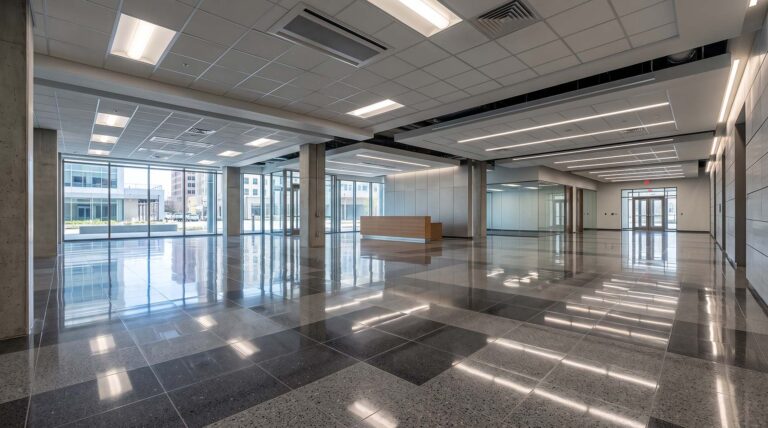
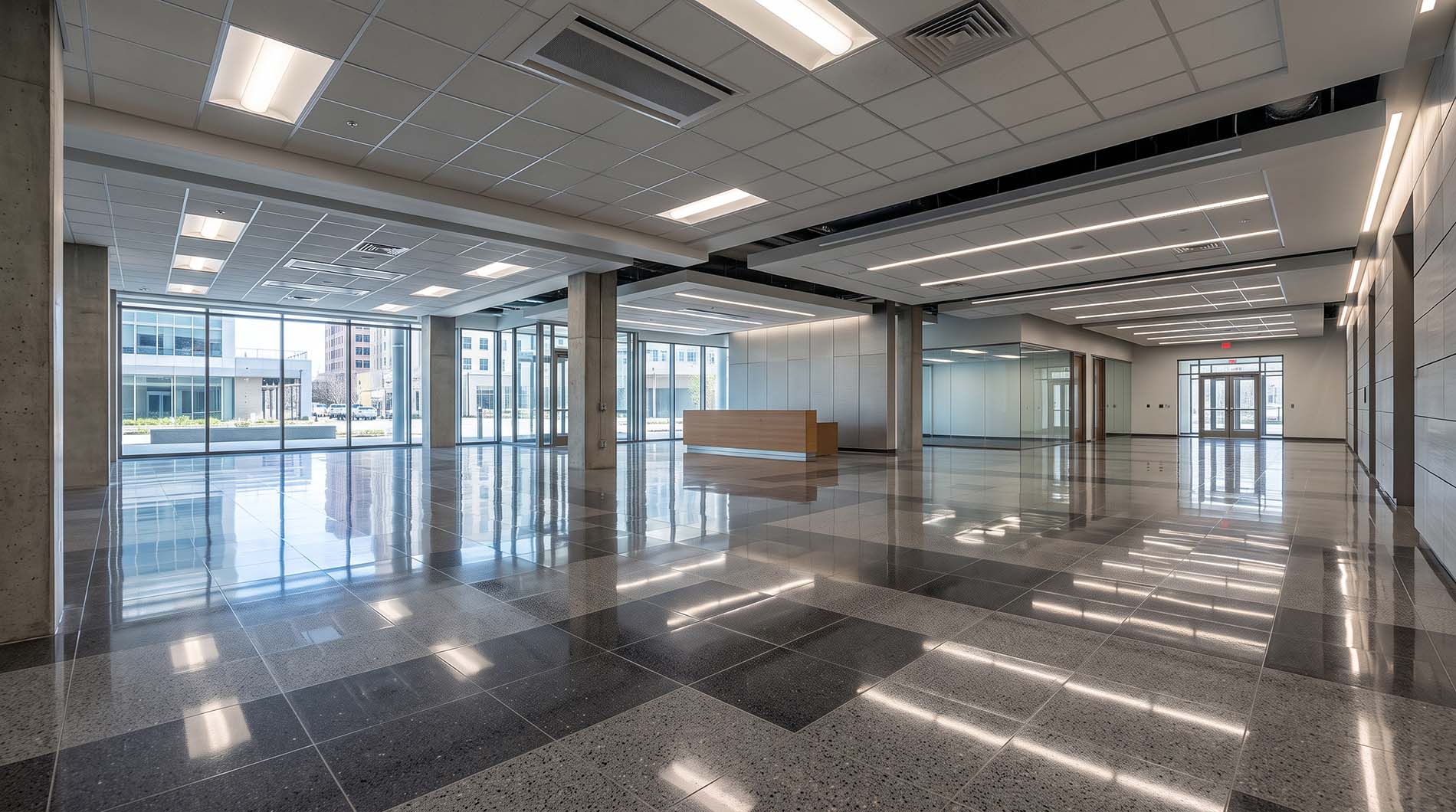
- Specialized Architectural Finishes: Matte black hardware, porous natural stone, unsealed terrazzo, and composite cladding demand specialized, non-toxic neutral cleaners to prevent surface damage.
For commercial and residential property managers in need of specialized local services, finding qualified post-construction cleaning in Roselle ensures safe handling of premium finishes.
Debris Volume, Waste Streams, and Disposal Logistics
Waste disposal arrangements directly impact cleanup proposals. If the general contractor provides on-site roll-off dumpsters within 50 feet of the building exit, labor costs remain standard. However, if the cleaning crew must haul away heavy debris, bag waste in heavy-duty contractor sacks, or manage separate recycling streams for LEED certification, haul-away line items generally add $150 to $800+ per load depending on volume and local transfer station tipping fees.
Defining Scopes of Work and Preventing Profit-Killing Scope Creep
Scope ambiguity creates friction between project managers and cleaning contractors. A clean floor can be covered in drywall dust within hours if other trades continue working. Setting clear expectations on scope prevents misunderstandings.
Multi-Phase Task Checklists and Exclusions
To avoid scope creep, contractors should maintain explicit checklists for every phase:
- Rough Phase: Clear packaging debris, sweep subfloors, damp-wipe window frames, and run initial vacuum passes over mechanical rooms.
- Final Phase: Scrape interior glass stickers, vacuum track systems, wipe down diffusers, clean millwork interiors and exteriors, sanitize plumbing fixtures, and auto-scrub flooring. Reviewing proven post-construction cleaning tips helps keep field superintendents and crews aligned on quality standards.
- Contract Exclusions: Hazardous materials (lead, asbestos, biohazards), exterior high-rise window drops, air duct interior cleaning, pressure washing parking structures, and active trade dust rework should be explicitly itemized as separate line items.
Protecting Margins Through Pre-Cleaning Walkthroughs
A joint walkthrough between the general contractor and cleaning lead protects project budgets. Walk the space 24 to 48 hours before the scheduled clean to confirm the site is ready:
- Active Trade Status: Are painters, tile setters, and electricians finished?
- Utility Access: Are operational water, functional floor drains, and permanent 120V power available?
- Pre-Existing Surface Damage: Document scratched glass, chipped tiles, or dented casework with photos before the cleaning crew begins work.
Scheduling a structured, thorough post-construction cleanup helps ensure turnover milestones are met without unexpected change orders.
Safety Standards, Essential Tooling, and GC Partnerships
Commercial jobsites are governed by strict safety rules. Commercial cleaning crews must comply with OSHA construction standards (29 CFR 1926), maintain site certifications, and use commercial-grade equipment to protect surfaces and indoor air quality.
Specialized Equipment and Dust Extraction Protocols
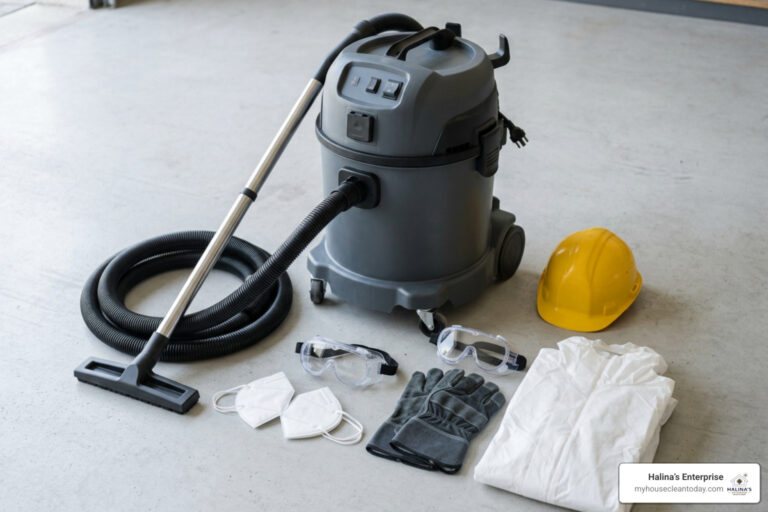
Standard residential shop vacuums cannot handle fine silica dust. Commercial cleaning requires professional tooling:
- Industrial HEPA Extraction: Multi-stage HEPA filtration units that capture particulate down to 0.3 microns, preventing fine drywall dust from recirculating into new HVAC systems.
- Walk-Behind Auto-Scrubbers: Commercial scrubbers with adjustable down-pressure and pad selections for epoxy, sealed concrete, luxury vinyl tile, and porcelain surfaces.
- Glass Scraping Tools: Professional stainless steel scrapers with fresh blades used with lubricated cleaning solutions to prevent glass scratching.
- Health-Focused Chemistry: Non-toxic, low-VOC formulations that clean surfaces safely without releasing harsh fumes into newly enclosed spaces.
Vetting Subcontractors for Repeat Commercial Projects
General contractors benefit from long-term partnerships with fully vetted cleaning teams. When reviewing trade partners across Schaumburg, Elk Grove Village, Hoffman Estates, Bartlett, Carol Stream, Naperville, and Chicago, verify:
- Comprehensive Insurance & Bonding: General liability coverage ($1M–$2M+), commercial auto, and statutory workers’ compensation policies.
- Consistent Crew Supervision: On-site bilingual leads who attend daily trade coordination meetings.
- Established Track Record: Decades of commercial trade experience and recognized industry standing, providing consistent quality across multiple builds.
Frequently Asked Questions About Commercial Cleanup Costs
What is the average square-foot rate for commercial post-construction cleaning in 2026?
Average commercial rates across the Midwest range from $0.10 to $0.30 per square foot for rough cleans, $0.30 to $0.75 per square foot for final detail cleans, and $0.06 to $0.25 per square foot for touch-up punch lists. Combined multi-phase turnover packages typically average $0.40 to $0.85 per square foot.
What tasks are typically excluded from standard construction clean up bids?
Standard proposals exclude hazardous waste abatement (mold, asbestos, lead), heavy structural trash hauling, exterior facade pressure washing, interior air duct cleaning, floor stripping/waxing (unless specified), and cleaning rework caused by trades continuing work after the final clean.
How do construction clean up rates compare to standard commercial janitorial pricing?
Post-construction cleaning rates run 2 to 4 times higher per square foot than standard daily janitorial services. Janitorial maintenance focuses on light maintenance (trash removal, surface wiping, dust mopping) at production speeds of 2,500 to 5,000 sq ft/hour. Construction cleaning requires deep dust extraction, heavy soil removal, paint scraping, and fine detailing, operating at slower speeds of 200 to 600 sq ft/hour.
Conclusion
Accurate construction clean up rates provide budget predictability and ensure smooth project turnovers. By understanding phase breakdowns, identifying site cost drivers, and establishing clear contract scopes, general contractors can plan accurate budgets and avoid turnover disputes.
Halina’s Enterprise brings more than 30 years of experience, award-winning service, and a health-focused approach using safe, non-toxic products to commercial projects across Roselle and the greater Chicagoland area. For your next build or tenant remodel, explore our comprehensive commercial post-construction cleaning services to secure reliable, on-time turnover support.